
The Last Threshold of Paradise
The Last Threshold of Paradise
Series: Cartographies of Inner Chaos
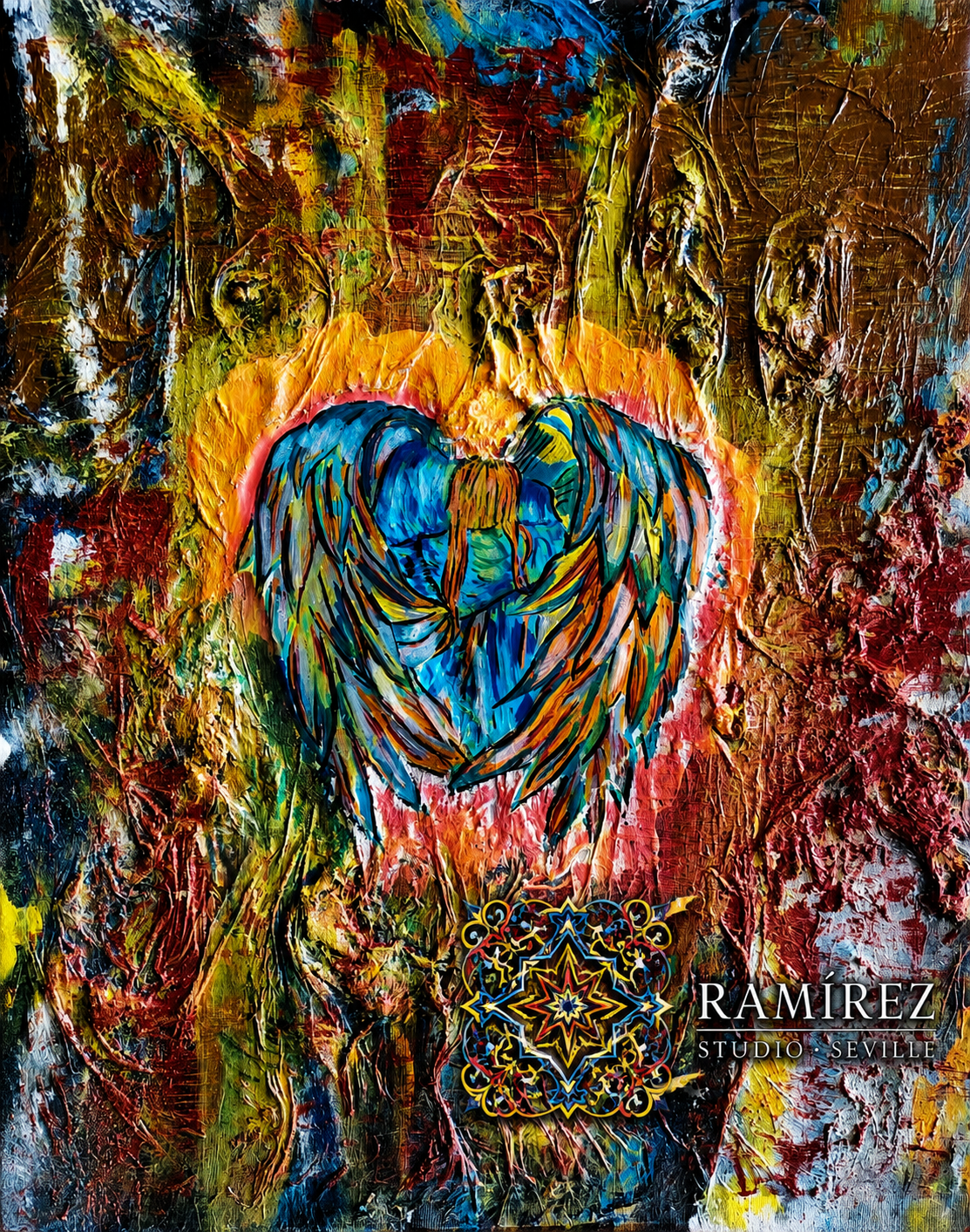
Inspired by the conclusion of Paradise Lost by John Milton, this painting explores Lucifer's most intimate and tragic moment: the instant in which he realizes that the Fall is not merely a physical punishment, but an irreversible separation from the light he once inhabited.
Far removed from the traditional image of the devil, the painting presents Lucifer as a being suspended between memory and emptiness. His wings, still infused with the celestial blues of his divine origin, fold around his body in a gesture of retreat that conveys vulnerability rather than power. They are no longer wings prepared for flight, but a final refuge against the awareness of irreparable loss.
The radiant glow surrounding the figure carries a dual meaning. It may be understood as the lingering echo of divine glory or as the fire announcing the beginning of eternal exile. This ambiguity forms the conceptual core of the work: Lucifer remains suspended between what he once was and what he is destined to become.
The background, built through heavy impasto and vigorous gestures, rejects any defined spatial setting. Its dense textures evoke a landscape dissolving before the viewer, as though Paradise itself were disintegrating alongside the protagonist's identity. The painted surface becomes a mirror of inner fracture.
Rather than illustrating a biblical episode, the work offers a meditation on the human condition. Lucifer's Fall symbolizes the tension between pride and freedom, between the longing for autonomy and the cost of abandoning that which once gave existence its meaning. In this sense, the figure transcends religious iconography to become a universal metaphor for every consciousness confronted with the consequences of its own choices.
This painting inaugurates the series Cartographies of Inner Chaos, a journey through the emotional landscapes of the human psyche. It begins with Milton's foundational myth of the Fall and gradually moves toward an increasingly psychological exploration of anguish, establishing a dialogue with the Expressionism of Edvard Munch. If Milton narrates the loss of Paradise, the works that follow investigate the inner landscape left behind, where chaos ceases to be a place and becomes a state of being.
"The mind is its own place, and in itself can make a Heaven of Hell, a Hell of Heaven."
John Milton, Paradise Lost